
I employed my usual strategy of refraining from web research, reading back labels or tasting notes, but I knew, I just knew in my heart-of-hearts that this wine was going to be heavy on the ethanol. No surprises to follow. And there’s no introduction required to this Barossa producer so I’ll throw myself headlong into the task of bringing you a snippet of Struie – a 100% shiraz from the Eden and Barossa Valleys.
Deep, inky, blood-red with purpling edges. Kind-of exciting to see this colour – you know you’re in for a biggie. Dense dark plum and liquorice greet on opening, with some syrupy mocha and punch of pencilly oak. There’s mint and spice – cinnamon and clove, white + black pepper. It’s brambly and earthy with a touch of savoury tomato, while the fruit spectrum covers the dark and brooding black stuff to rich, red and blueberry aromas – it’s raisiny and sweet-smelling. Other characters I jotted down include caramelised fig, toffee apple, vanilla pod. It’s lush and plush.
The palate is red-fruited raisins, some blackcurrant slipping through, white spice and pepper and a little star anise mintiness. Chewy and flavoursome – savoury like rich, slow-cooked ragu, or tarry backstrap molasses, and sweet like a fiercely baked blackberry pie. This wine is cookin’. Rounded and complex, texturally soft and pliant – the tannins seem to be either very fine, or softened. The alcohol fleshes out the back palate with the dense, yet sinuous oak. They’ve really backed off the structural elements – tannin/acid – to bring you a wine of suppleness and flavour. Viscous to all hell.
Vibe
I enjoyed this. It was worryingly drinkable for a high-alc style. But to be honest, it doesn’t really have the X-Factor that you would expect from this label, and you know I love an X-Factor. Yes, the alcohol shows (it says 15% on the label, but who knows?), but it’s not overdone for the style of wine. I think I enjoyed the recent bottle of big-alc Kay Brothers more than the Torbreck (see here for the Kay’s) but altogether this was an enjoyable beast over two nights – one with pizza, and one with lamb roast. Is good, is Torbreck, is not cheap, is not short of fans, is worth a look.
Value: Current release (2009) is $48.50 at cellar door. I vaguely recall buying this 2007 for $40-ish somewhere, so that makes sense. I think it’s OK, considering The Factor is currently $125 and The Laird $700.
Tasted: July 2011
Closure: Cork (a good specimen)
Source: Purchased
Tech-head
Producer: Torbreck – www.torbreck.com – established in 1994 by Dave Powell, formerly of Rockford. A share-farming and semi-virtual enterprise until the 2000’s when they acquired their own property – the Hillside vineyard in Lyndoch – and established their own winemaking and cellar door facility on a nearby property.
Region: Barossa and Eden Valleys, South Australia. Eden provides the varietal clarity and structure while the Barossa provides the power.
Site: 40 year-old Eden, 80 year-old Barossa.
Winemaking: Matured in old and new French oak for 18 months.
Vintage: Eden was hot, the hottest for a long time. The preceding winter was dry too. A little rain in Feb eased the pain. Early, short – yet she was a hottie and correspondingly a goodie. Much the same in Barossa – an early and short vintage, low yielding, but some good quality amongst the carnage.
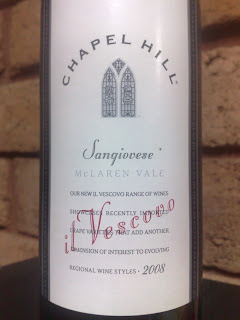
This, my second review featuring a wine from Chapel Hill’s ‘il Vescovo’ range – the first can be found here – and I don’t mind saying up front (spoiler warning!), I liked it muchly.
Sangiovese around the world can look decidedly different whilst managing to maintain the basic characteristics of the variety. But does anyone do it as well as Chianti? It’s a style thing. So yes, and no, but don't expect an essay on it here. This beauty from McLaren Vale does a pretty fine job of it. Here’s what it looked like:
Lively blood red, bright colour. A note of charry oak greets the nose, a little varnishy; some vanilla-scented spice, musk. Lovely floral aromas of lavender and violets, a touch of liquorice and tar – attacking the nose – some herbal stalky elements, and a yummo whiff of Thai red curry. There’s some coastal heath and native shrubbery notes, and that’s a good thing as I’m a guy who likes a bit of coastal heath and native shrubbery. I also get a sweetish ribena-like character which is a whole lot better than it probably sounds. Ribena for grown-ups.
The palate is round, supple, yet dense and lively. Mouth-watering is the right word, featuring redcurrants and blueberry pie, dark cherry, dried prunes and figs, raisins; and a lovely tomatoey savoury/sweet flavour. Structurally precise, balancing flavour-weight, oak, tannin and acid. The raisiny flavours were so seductive, like a coffee hit.
Vibe
Seductive, addictive, and a high drinkability factor. Seems to have nailed the savoury/sweet combo and although the wine looked even better with pizza (naturally), it handled itself with aplomb sans food.
Value: A very, very reasonable $22 a bottle – a bargain I say.
Tasted: July 2011
Closure: Screwcap
Source: Purchased
Tech-head
Producer: Chapel Hill – www.chapelhillwine.com.au – owned by the Swiss-based Schmidheiny family since 2000.
Region: McLaren Vale, South Australia.
Site: The Kangarilla Vineyard in the foothills of the Mt Lofty Ranges at the eastern edge of McLaren Vale.
Winemaking: Open fermenters, hand-plunged, eight days on skins before basket-pressing. Matured in 2, 3 and 4 year-old French oak for 16 months.
Vintage: Good winter rains followed by a dry spring. Although January was a hottie, the remainder of summer provided ideal ripening conditions. Generally a good year.


Well it started small, and as things happen it got a little out of hand and bottles just kept getting opened. A mate was cleaning out the cellar and asked a few buddies to join in a tasting of random wines – all Margaret River – from 1989 to 1999. The following are brief notes on the wines.
The wines are scored as per wine show criteria and based on all tasters feedback. Yes, I hate pointing but in a tasting of this nature it’s helpful to be able to ‘rank’ the wines, as opposed to scoring on a single basis with no comparative. The wines were also tasted before food, and during food, and this affected the results somewhat. They were also tasted over several nights because there was shitloads left and we didn’t want to throw them out.
The wines, by admission, had travelled widely and the storage had been less than desirable on occasion, but all were judged on the merit of the glass in front of us. Comments below referring to brettanomyoces are for information purposes only, and not to fault the wines unless excessive. It should be understood that it was not until the late ‘90’s when Australian winemakers really learned what brett was all about and how to handle it. Too late for a few of these wines.
This tasting was a real cork fiesta for those that froth at the mouth over bark seals and lotteries. It’s difficult to judge a wine and vintage based purely on a single bottle analysis under cork. This was a tasting not about great wines, but great bottles... as they say. But here goes (wines listed in vintage order):
1989 Xanadu Reserve
Browning coffee colour. Initial hit of tar and char, some medicinal mint – befitting both the location and producer – and the merest, tiniest hint of brett. Opened to coffee and chocolate characters, potpourri and the scent of an Indian spice market. The palate opened ragged and raw, but boy did this one settle down with plush, plummy, blackcurrant fruit. Bloody good and still looking the goods on night three – 18.
1989 Leeuwin Estate
Browning coffee colour. Smoked meats on the nose, cedar and tobacco, a touch sweaty with some vegemite aromas which I would normally associate with low-level brett, but in this case I think it more age and site-related. Further on the nose: tar and char, inky redcurrants and perfumed spice, and a touch of curry. There’s a lean-ness on the palate and a contrasting richness which, after time in the glass, takes over. Very bloody good, although had diminished on night three – 18.5.
1990 Xanadu
Herbal blackcurrant, meaty and leathery – showing its age. There’s some lingering richness and coffee choc flavours, but on the whole this wine was viewed as past best, drying and tired. But not bad for the ‘standard’ label – 15.
1990 Xanadu Reserve
Browning coffee colour. Lovely earthy blackcurrant and trademark Xanadu mintiness. Dense molasses and tar, cocoa butter, some herbal elements but also sweet confection and spearmint. Structure still sound, tannins a little dry perhaps but this is very smart for it’s age – 18.
1991 Xanadu
Red brick colour. Earthy blackcurrant, dusty, marshmallow sweetness. A driving tarry aroma hits hard and genuine primary blackfruits. Looks quite fresh. The bouquet offers floral scents of violets, rose-petal and lavender, plus an attractive hint of Thai green curry paste. Huh? Yeah! Palate is weighty for the age, with dense red and blackberry flavours, earth, spice, and just the slightest hint of brett which I was quite happy to forgive. Nice – 17.5.
1991 Xanadu Reserve
Sadly, maybe cork-related, rooted.
1992 Xanadu
Lighter, transparent brick red colour. Intense blackcurrant. Clean, lifted aromas. Straightforward and still quite neat structure – firm tannins, acid still hanging – aromas of mint, choc cherry. Raspberry and redfruit flavours. Simplish, but elegant, and a good blend of savoury and sweet. Loved the food. Nice gear – 17.5.
1994 Cape Mentelle
Warm brick red. Hints of bandaidy brett – a little too much – but behind that we have some lovely dense, brambly blackberry and some very stylish oak, fresh. Bugger the brett. Tarry and charry BBQ meat. Savoury/sweet. This could've been a contender but the brett killed it’s chances – 15.
1994 Mosswood
Warm brick red. Meaty and herbal, dusty – some black tar and a touch of perfume. Some Indian spice on the palate, blackcurrant/blueberry. But something’s not quite right. Maybe cork, hard to say. Expected better – 15.
1994 Leeuwin Estate
Dark brick red. Dusty black olive, fresh savoury/sweet combo. Raspberry redcurrant, plummy. Strong core of cedar and gum (classic Leeuwin). Satsuma plums and tar. Densely layered, fresh, sumptuous. Teeniest hint of brett but nothing to be concerned with. Tannins still firm, but generally structure holding up splendidly. This is good – 18.5.
1995 Vasse Felix
Dark brick red. Touch of brett leaps out but a vein of dark chocolate richness sweeps in. A ripe year in ‘95 and you can see it here. Light and airy sweetness on the palate – redcurrants and blueberry pie. Another goodie spoiled by excessive brett – 15.
1996 Amberley Estate (Cabernet Merlot)
Browning brick red. Dark and brooding nose, some lean-ness, but clean and a driving core of dark fruits. Liquorice, coffee and tobacco, some BBQ char. Is good. It put some of its better-known siblings to shame – 17.5
1996 Xanadu Reserve
Inky brick red. Wow. Hallmark Xanadu mint leaps out of the glass, sweetish yet tarry. Blackcurrant velvety richness, great length. Meaty, curry flavours spring to mind also. In pretty smart condition and came alive with the spicy food later in the eve. A good one – 18.5.
1997 Rosabrook (Cabernet Merlot)
Corked.
1998 Amberly Estate (Cabernet Merlot)
Something wrong with bottle number one, and a subsequent bottle was marginally better. Safe to say the wine had succumbed to faults and/or possible cork issues.
1998 Vasse Felix
I’m afraid the brett fairies have escorted this wine to the back of the secret garden where we can no longer see it for the good wine it once probably was.
1999 Rosabrook (Cabernet Merlot)
Inky-black deep red. Bounced out of the glass with Margaret River maritime fishiness – not altogether a bad thing. Some burnt rubber sulphidey issue which caused a second bottle to be opened which fared better. Smoky and minty, sweet/savoury stuff going on, dark and red-fruits, with typical blackcurrant richness. A warm year in Margs, and although this was not earth-shatteringly good, it’s holding up pretty well. Or this bottle was – 16.5.
1999 Sandalford
Hmmm. Vegemite and vomit unfortunately. That’s about all I can say.
Vibe
In summary, this was a very good smattering of older Margaret River cabernet, from a cellar that has apparently been well-travelled and spent occasional periods under somewhat poor conditions. This tasting showed the strength of Margs cabernet to go the distance, and particularly the wines in the cooler years where, in their youth, richness and flavour may have given over to structure and form.
Brief Vintage Rating
1989 – a wildly under-rated year of inclement weather and intense bird pressure, but this tasting proved the ugly ducklings could be belle of the ball.
1990 – considered a very good year. A dry, mild summer allowing grapes to reach full sugar/flavour ripeness. Some excellent wines produced.
1991 – one of the best, although the debate rages between this and 1990. Some heat spikes early in vintage in an otherwise ideal harvest season.
1992 – considered a Jekyll/Hyde vintage. The winter and spring was difficult, yet summer turned on the good weather. Late rain during vintage impacted some. All about structure.
1993 – dry and cool year after hail had reduced yields significantly. Some good wines made. A good year. (no wines from 1993 featured in our tasting)
1994 – another of the best – perfect ripening conditions. Cooler later in the vintage but this year the structure was matched by richness and flavour.
1995 – hot baby, hot. But even under these conditions Margaret River showed what it’s made of with wines of power, yet finesse. Great year.
1996 – another very good vintage, with ideal ripening conditions producing wines of fine structure and flavour concentration.
1997 – a good year that almost wasn’t. The weather gods kept the rain at bay and Margaret River basked in sunshine and warmth.
1998 – a mixed bag, with mid-harvest rains and bird craziness. Those who waited out the rains were rewarded with ripeness and structure. A difficult year.
1999 – late season, and warm/hot. Some mid-harvest rains again but wait, wait, wait was the buzzword. Some big flavours in this year and matching structure. A beauty.
 Big bottle. Wax seal. Diam cork. As you progress through the ritual of opening this wine, the moment arrives when you pour the wine from the heavy glass vessel, and there’s an expectation you’ll see an inky black liquid oozing from the neck into your wine glass. But it’s not inky black. It’s light and transparent, with brick red hues like a pinot; unexpected really, but that’s the colour of this nebbiolo.
Opening notes of mint and raspberry lead to a wide spectrum of aromas ranging from the floral: violets and lavender, to the herbal: wild heath, sage and anise: to the savoury and dry: black tea, char, white pepper and tomato pizza sauce base (yes, I love balsamic!). There’s strong pencilly notes too – perhaps an oak derivative – but the general tone is in the red-fruited spectrum.
The palate runs with a similar reddish theme of raspberry and cherry flavours; a touch of marshmallow sweetness. There’s great drive and depth of flavour, but without the weight – that’s OK, it doesn’t need weight. It’s supple, textured and layered; seductive and savoury; with surprisingly citrussy acid and firm, yet fine, tannin. There’s some smoky char and tar too. It works a treat with food – on this occasion: pork sausage, roast potato, sundried tomato and olives.
It has the X factor, of which I am particularly fond yet inadequately equipped to elucidate with any precision. I think the best is yet to come. Hell, it’s still evolving in my glass.
Vibe
I like it, as is obvious by now. I think I’ll start scoring wines in this blog with a simple X factor – yes, or no. OK, that may be a little simplistic. But this is another wine that speaks clearly of variety and place when supped alone, yet evolves and sings loudly when coupled with food.
Value: It ain’t cheap at $38 a bottle, but it’s one of those ‘gotta try one’ wines.
Tasted: June 2011
Closure: Diam (appears clean)
Source: Purchased
Tech-head
Producer: Luke Lambert Wines – www.lukelambertwines.com.au – cultish producer, but don’t let that put you off. Based in the Yarra but this wine from Heathcote.
Region: Heathcote, Victoria.
Vintage: Good winter rains followed by a warm spring and summer, ending hot in some parts. Generally a good Heathcote year.
 I’ve been under the weather this weekend and had to postpone a big tasting I had planned with a few buddies yesterday. But before I succumbed to the horrendous man-flu that cut me down so savagely in my tracks, I snuck this wine in. Here’s a brief note on it.
I don’t usually read anything on the wines I’m tasting so I’m not distracted or influenced by others. Nor do I read the back labels, so I don’t even know the wine handling usually. I went in blind on this one. Pinot gris is a tough ask on wine-tasters – my partner likes them, and when quizzed she says ‘because they don’t have much taste’. Hardly a recommendation I know, but sometimes you just want a simple white wine and not have to think too hard about it. That’s pinot gris. So, although I was expecting the usual non-descript pinot gris style, I was pleasantly surprised to find much more.
Lovely aromatics of rose petal and sherbet, some green apple and nashi pear. There were some herbal qualities too, in a nice way – imagine rubbing a fresh bay leaf between your fingers before smelling them. Also liked the orange rind-iness. And the honeyed lime.
Taste-wise I picked out some limey citrus flavours and some marzipan, but the remainder fitted into the floral/spice spectrum: sandalwood, musk, rosewater – and ending with ripe stone fruits: peach, nectarine. There’s a creaminess and layering on the palate too which led me to suspect some barrel work. It’s very well-handled – there, but not there – if you know what I mean.
Vibe
This is probably the most enjoyable pinot gris I’ve had in many a moon. Quite pleased with my tasting efforts too, as my notes uncannily reflect what the Printhie dudes wrote on their back-label – an unusual occurrence. But it's the booze that matters, and this is good booze.
Value: Very good value at $17.
Tasted: June 2011
Closure: Screwcap
Tech-head
Producer: Printhie Wines – www.printhiewines.com.au – owned by The Swift family.
Region: Orange, NSW – the NSW central tablelands east of Sydney – a wine region of high-ish elevation.
Vintage: A difficult vintage with yields down across the board for many – although some excellent quality prevailed.
 This wine appeared in a sample pack I received a few months ago and I’ve only just got to it. Yes, I know it says 2009 and I bet you’re all groaning right now. But I have to tell you, I didn’t check the vintage before opening and tasting this wine and assumed from the outset it was current vintage, being 2010, until I looked at the label. It actually looked pretty fresh for it's age.
Willow Bridge Estate are a sleeper out here in WA – we’ve all heard of them, but not many wine nerds probably get around to giving them a crack (this nerd included). They’re roughly 10 years old, and based in the Ferguson Valley (where?). They’ll hate me for saying this, but to set the scene for you, the Ferguson Valley is located approx 100km north of Margaret River in the hills immediately to the east of the regional city of Bunbury. It’s quite a little tourist hub now, can be very pretty, and is worth a visit on your WA trip.
The winemaker is Simon Burnell, formerly of Cape Mentelle in Margaret River, so he knows his stuff. Fruit for this particular wine is sourced from the Pemberton wine region, located south-west of the Ferguson Valley. I love Pemby Savvy. Alright, I know, I’ve probably confused you all now. It doesn't really matter. Read on..
Colour is pale to golden straw. All pineapple and marshmallow, flinty minerality and nettles. Some herbals/florals – nice – and some attractive spice characters in the form of anise and vanilla. Lively pungency still, soft in the acid department, and finishing with sweetish banana passionfruit aromas.
The first thing that I note on the palate is the creamy texture, which I’m guessing is aided by the partial natural fermentation. Flavours are in the greener tropicals – kiwifruit, rockmelon – and some citrussy lemon. On the fringes there’s herbal flavours of lemon myrtle, and lemongrass. Too much lemon you say? Oh, and a bit of lime and a touch of lovely wheatgrass.
Vibe
This does look pretty fresh for 2009 and is drinking well right now. Pemby is quite a bit cooler than Margaret River and therefore the wines exude a bit more lean, yet punchy, minerality, and a bit less of the tropical stuff. When they get the balance right, it’s very nice indeed. I enjoyed this and will probably seek out the 2011 version when it’s ready later this year. I think this wine forms part of the ‘Winemakers’ range, which, thankfully, has undergone a label change in recent times.
Value: The current release is $25 – I’m assuming this wine was in line with that. Up there, but a decent drop.
Tasted: June 2011
Closure: Screwcap
Tech-head
Producer: Willow Bridge Estate – www.willowbridge.com.au – Established in 1996 by the Dewar family.
Region: Ferguson Valley, Western Australia, although this wine is from the Pemberton region, south-west of Ferguson.
Site: Well-drained Marri soils, ironstone gravelly loam over clay.
Vintage: A top vintage in Pemberton – good winter rains preceded a mild and warm growing season without weather extremes or disease.
This wine picked up the Trophy for Wine Of The Show at the WA Boutique Wine Awards – a show I’d never heard of before now. (Turns out to be the Blackwood Valley region’s local event, and I guess any producer of a certain small size can enter). I’m not gonna say the judges messed up, but this wine must've looked a whole lot better in 2008 when it won the Trophy.
The green stalkiness on display is just too much and I found my notes peppered with the word 'green' throughout. The dominant aroma was freshly cut capsicum. OK, major negative dealt with swiftly.
On the plus side there’s a pulsing, driving blackcurrant thread on the nose and throughout the palate, some lovely BBQ char and tar aromas, savoury black olive. Herbal notes include bay leaf and sage, and there’s tobacco leaf and eucalypt wrapped in vanillan oak.
The palate has some decent flavour weight and length, but the greenness and herbal spectrum of flavours dominate, in my view. The dense, chewy blackcurrant is attractive. I feel the structure also lets this wine down a bit – the acid is still too crunchy and seems out of kilter with the rest of the elements.
Vibe
I hate to say it but this was a bit of a disappointment. Further on-line research shows it never soared to the heights of the Trophy in WA, winning Bronze medals elsewhere and 89 points from Halliday. Look, it’s not a bad, bad wine. It’s just not a Trophy-winner in my book.
Value: The current release is $32 so I’m assuming the 2007 vintage was around the same, or slightly less. I think that price is a little too high for this wine (2007).
Tasted: June 2011
Closure: Screwcap
Tech-head
Producer: Windows Estate – www.windowsestate.com.au – Established in 1996 and now owned by the Davies family, the winery/vineyard is located at the northern end of Margaret River (near Yallingup).
Region: Margaret River, Western Australia.
Site: Gravelly and sandy soils over a clay base. The website declares the property as dry-grown.
Vintage: A mild winter leading into a warm and early vintage, finishing hot. A much-heralded vintage in Margs with many wines achieving great show success around the world, especially for cabernet.


